When regulations and price are the only criteria for selection, the quality of the project is compromised.
When designing heating systems for new buildings (especially in collective residential, tertiary or industrial projects), there is one key decision that affects the entire life cycle of the building:
Are we choosing the best possible technical solution… or simply the one that complies with regulations and fits within the initial budget?
This decision, which is common in the design of heating systems for new residential and commercial buildings, determines not only regulatory compliance, but also the actual performance of the building over the next 20 or 30 years.
Index
Compliance with regulations does not always mean optimising the installation.
The RITE and CTE (DB-HE) establish the minimum requirements for energy efficiency, control, safety and use of renewable energies in new buildings.
In practice, this has made heat pumps one of the most widely used solutions, as they allow for:
Reduce consumption of non-renewable primary energy
Easily reach the limits of HE0 and HE1
Complying with renewable contribution requirements in DHW
However, not all heat pumps offer the same performance, nor do they respond equally to actual project demands.
This is where the first common mistake arises: thinking that any heat pump that ‘complies’ with regulations is the best technical solution.
The heat pump as a central system... well defined or simply selected?
In many projects, the heat pump is introduced as an almost automatic decision, without an in-depth analysis of:
Actual thermal demand profile
Continuous or peak DHW production
Simultaneous use (DHW + heating + cooling)
Ventilation requirements and integration with other systems
Control and regulation strategy
When this occurs, the installation may comply with regulations but not operate at its optimum level, which translates into:
Actual SCOP lower than expected
Higher electricity consumption
Shorter equipment lifespan
Problems with comfort or availability of DHW
DHW: the great forgotten (and most critical)
In new buildings, especially in collective residential buildings, hotels, hospitals, or sports facilities, the production of domestic hot water represents one of the highest energy consumptions.
In many projects, the performance of the DHW system is what really defines the success or failure of the heating installation. Here, the heat pump should not be considered as a ‘complement’, but rather as a strategic system, taking into account:
Actual production temperature
Cumulative volume
Peaks in demand
Anti-legionella strategies
High-temperature performance
Choosing a heat pump for DHW solely on the basis of price or regulatory compliance can result in oversized, inefficient or inflexible systems.
Comprehensive systems: when a single solution changes everything
The evolution of the sector has led to an increasingly common focus on well-resolved projects. This is not a valid solution for all projects, but it is an increasingly interesting alternative when analysing the system as a whole.
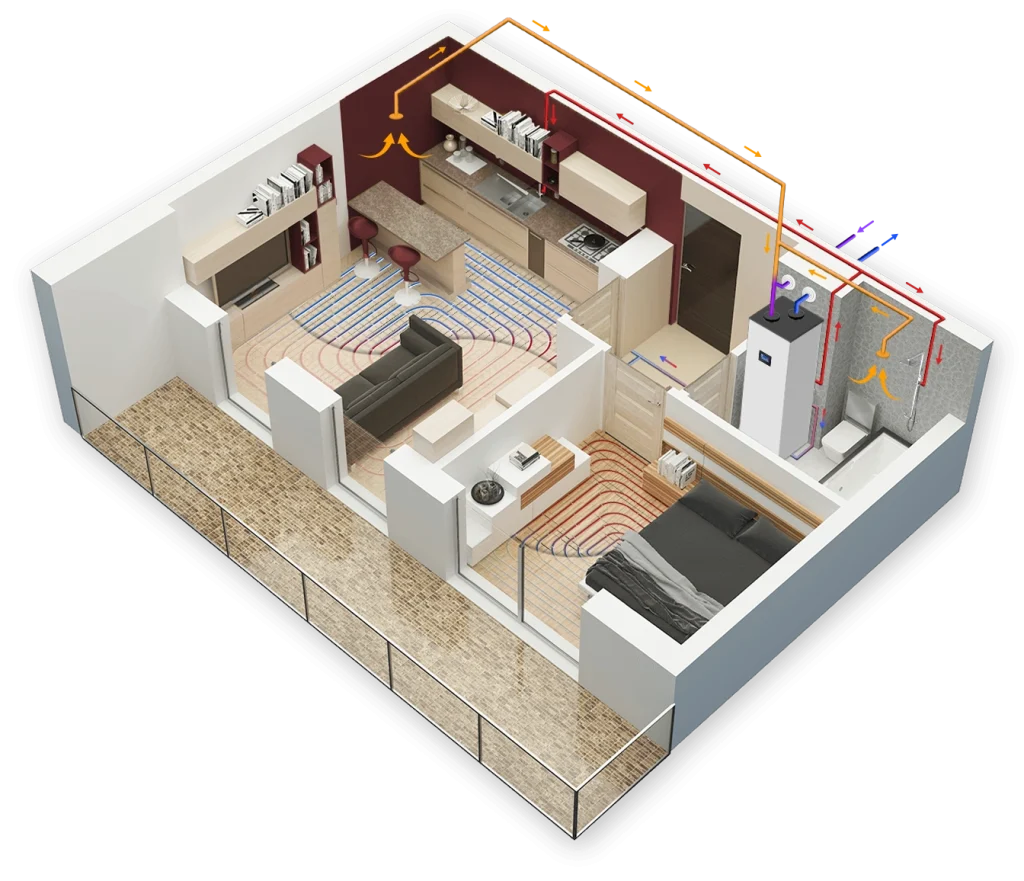
Heat pumps that produce DHW, heating, cooling and ventilation in a single integrated system.
These types of solutions enable:
Simplify the technical room
Centralise control
Reducing energy losses
Facilitate maintenance and management
Improve the overall seasonal performance of the building
Stability under partial loads and variable demands
However, for this to function correctly, the equipment must be specifically designed for that use, not adapted from a standard solution.
Price vs. Performance: a decision with long-term impact
It is understandable that the budget carries weight in the project phase, but in complex thermal installations, the initial cost is not the most relevant indicator.
A correctly selected and sized heat pump can mean:
Lower annual energy consumption
Reduction in operating costs
Greater operational stability
Better response to variable loads
Ample compliance with current and future regulations
In many cases, the operational savings more than offset the initial investment difference.
The role of the manufacturer in the design phase
This is where a key difference arises between choosing equipment and designing a solution.
A manufacturer specialising in projects must provide:
Technical assistance from preliminary design stage
Adapting equipment to actual demand
Specific configuration for DHW, air conditioning or integrated systems
Support in regulatory compliance and energy efficiency
Not only as a manufacturer of heat pumps, but also as a technical support provider during the project phase, with the aim of helping to define the most appropriate solution for each specific case, respecting the designer’s criteria, the architect’s vision, the developer’s requirements and, of course, the regulatory framework.
This approach provides engineering firms with technical support that:
Technical assistance from the preliminary design stage
Facilitates technical and energy justification
Helps optimise system performance
Avoid oversizing or forced solutions.
In short, Efitherma helps to ensure that the heat pump is no longer an isolated element but becomes part of a coherent, efficient thermal solution that is well integrated into the project.
Conclusion: compliance is mandatory, optimisation is a technical decision.
Choosing a heat pump just because it fits the regulations or price may solve the problem on paper, but it does not always solve the problem for the building.
When technical criteria guide the decision, the benefits are clear: greater real efficiency, better long-term performance, and more efficient, future-proof installations.
The regulations set the minimum
Engineering defines the quality of the project
And in a context where the heat pump is already at the heart of the heating system, choosing the right manufacturer and technical approach is just as important as choosing the technology itself.