How is Legionella prevention ensured in DHW systems with heat pumps?
The production of Domestic Hot Water (DHW) in residential buildings, hotels, hospitals and sports facilities entails a significant health responsibility. One of the main risks associated with these systems is the potential proliferation of the bacterium Legionella pneumophila, which causes legionellosis, a disease that can lead to serious respiratory infections.
In this article, we look at what Legionella is, what health regulations require, what temperatures must be reached, and how anti-Legionella cycles work in modern DHW systems.
Index
What is Legionella and why does it pose a risk in DHW systems?
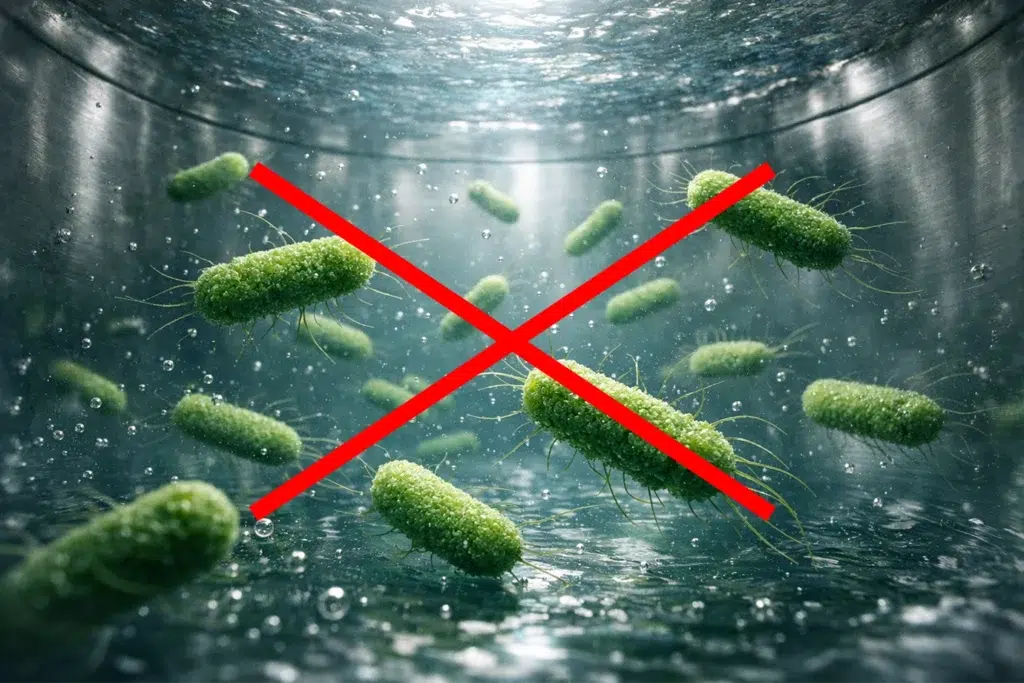
Legionella pneumophila is a bacterium that thrives in aquatic environments and can proliferate in water systems when certain temperature and stagnation conditions are present.
Transmission to humans occurs mainly through the inhalation of contaminated aerosols generated by showers, taps or spray systems.
DHW systems can become a breeding ground for such issues if factors such as the following are not properly managed:
Water temperature
Circuit blockage
Presence of biofilm in pipes or storage tanks
Lack of maintenance or regular thermal disinfection
For this reason, DHW systems must be designed and managed in accordance with specific hygiene criteria that minimise the risk of bacterial growth.
Regulations on the prevention of Legionella in DHW systems
In Spain, the prevention and control of Legionella is primarily regulated by:
Real Decreto 487/2022: Sets out the health requirements for the prevention and control of legionellosis.
This regulatory framework sets out a series of technical and health-related criteria for water installations, including DHW systems. The most important aspects include:
Water temperature control
Hydraulic design designed to prevent stagnation
Maintenance and cleaning programmes
Thermal or chemical disinfection protocols
Recording of operations and health checks
Temperature control is one of the most effective and widely used methods for preventing the growth of Legionella in DHW systems.
Temperatures to prevent the spread of Legionella
The behaviour of Legionella bacteria is closely linked to water temperature.
Water temperature
Bacterial behaviour
< 20°C
The bacterium remains inactive
20°C – 45°C
Optimal growth zone
50°C
The bacteria begin to die
60°C
Quick removal
70°C
Immediate thermal disinfection
For this reason, DHW systems must be designed to meet certain thermal requirements. Common recommendations for plumbing systems:
≥ 50°C
Temperature at terminal points
≥ 60°C
Accumulation temperature
≥ 60-70°C
Periodic thermal disinfection
These temperatures allow the presence of the bacteria in the Domestic Hot Water system to be reduced or eliminated.
Anti-Legionella Cycles: How do they work?
Anti-legionella cycles are a thermal disinfection procedure used in hot water supply systems to prevent bacterial proliferation. The process involves temporarily raising the temperature of the stored water to levels capable of eliminating the bacteria, typically between 60 °C and 70 °C, for a specified period.
This process can be programmed to run automatically in many modern DHW production systems.
Objectives of the Anti-Legionella programme
Eliminate bacteria present in storage tanks
Disinfect the hot water circuit
Ensure safe sanitary conditions
Comply with the prevention protocols set out in the regulations
Usual frequency of performance
Depending on the installation, these cycles can be programmed:
Weekly
Monthly
After prolonged periods of inactivity
The automation of these cycles is particularly important in hotels, hospitals or buildings with high DHW consumption, where hygiene standards must be maintained at all times.
Anti-Legionella cycle in Efitherma heat pumps
Efitherma heat pumps feature a specific, automatic anti-Legionella cycle function, designed to ensure the hygiene and safety of the DHW system through scheduled thermal disinfection.
This function allows the temperature of the stored water to be temporarily raised in order to eliminate any bacteria present in the system.
Configurable parameters for the anti-Legionella cycle
Efitherma heat pumps allow you to configure various settings to tailor the system’s operation to each installation:
Anti-Legionella temperature setting
The system allows you to set a disinfection temperature between:
60°C | 70°C
This range allows for the application of appropriate heat treatments tailored to the requirements of each facility.
Programme schedule
The system allows you to schedule the cycle by selecting a date and time:
Efitherma heat pumps are equipped with state-of-the-art control systems, thanks to their touchscreen controller (TST Control Display) and remote management via the EFI SmartApp.
Thanks to these, you can configure settings such as the following:
Monitor the operation of the DHW system
Change the settings for the anti-Legionella cycle
Adjust temperatures and operating times
Control the installation from anywhere
This connectivity makes the work of installers, maintenance technicians and facility managers easier, enabling more efficient and secure management of the system.