

Efitherma Marketing Department
In recent years, the Netherlands has established itself as one of the most advanced European markets in terms of the adoption of heat pumps.
The transition to low-emission buildings, the promotion of renewable energy and public incentives to replace traditional systems are a key part of the country’s energy strategy.
It is necessary to ensure that the heat pump complies with current regulations, has the appropriate documentation, is eligible for available grants and is suitable for the climatic conditions in the Netherlands.
Although all manufacturers sell their products on the European market, not all heat pumps are equally well equipped to meet the demands of the Dutch market. Factors such as registration with EPREL, eligibility for ISDE grants, the use of environmentally friendly refrigerants, and compliance with certain technical standards can make all the difference to a professional project.
In this guide, we will examine the key features that engineering firms, architects, property developers, distributors and installers should take into account before selecting a manufacturer for a project in the Netherlands. The aim is to provide a clear, practical overview based on technical criteria to help you make more confident decisions.
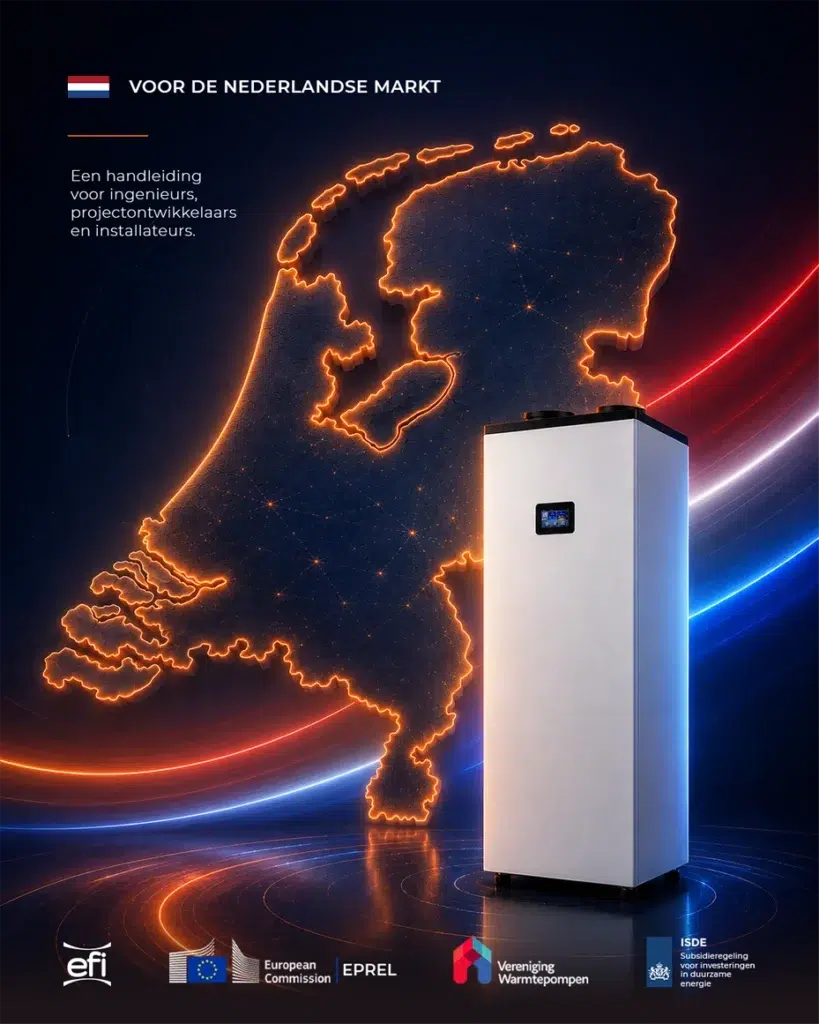
Although European Union regulations establish a common framework, each country has different needs, incentives, and selection criteria.
In the case of the Netherlands, the commitment to the electrification of buildings and the gradual reduction in the use of natural gas has placed heat pumps at the heart of the energy transition. For this reason, price is no longer the main selection criterion; factors such as the following now play a role:
In the following sections, we will analyze all the most important aspects—which are, at the same time, the least known to many professionals.
The first requirement that any heat pump intended for the European market must meet is compliance with the relevant EU legislation. Although many of these certifications are mandatory for marketing the product within the European Union, being aware of them also enables an assessment of the manufacturer’s level of commitment to quality and regulatory compliance.
These are the main regulations and guidelines you should check:
| Certification or regulations | What does it guarantee? |
|---|---|
|
CE Marking
|
The product complies with the essential safety, health and environmental protection requirements laid down by European legislation.
|
|
EN 14511
|
It sets out the test methods for determining the thermal capacity, electricity consumption and coefficient of performance (COP) of heat pumps.
|
|
EN 14825
|
It sets out the method for calculating seasonal performance (SCOP and SEER), providing a much more accurate picture of the heat pump’s actual performance throughout the year.
|
|
Ecodesign Regulation
|
It sets out the minimum energy efficiency and eco-design requirements for heat pumps placed on the market in the European Union.
|
|
Energy Labelling Regulation (ERP)
|
It requires heat pumps to be classified using an official energy label, making it easier to compare products.
|
|
PED (Pressure Equipment Directive)
|
It regulates the safety of pressurised heat pumps, including components of the refrigeration circuit.
|
|
EMC (Electromagnetic Compatibility)
|
It ensures that the heat pump does not generate electromagnetic interference and operates correctly alongside other electrical appliances.
|
|
LVD (Low Voltage Directive)
|
It sets out the electrical safety requirements for low-voltage heat pumps.
|
Taken together, these standards make it possible to verify that the product has been designed and tested in accordance with European safety, efficiency and performance requirements.
However, complying with these standards is not always sufficient to meet the specific needs of the Dutch market.
One factor that is often taken into account by distributors, engineering firms and public bodies is whether the heat pump is registered with EPREL (European Product Registry for Energy Labelling).
EPREL is the European Union’s official database where manufacturers register products subject to energy labelling. Its purpose is to provide transparent and verifiable information on the energy performance declared for each heat pump.
For a heat pump, this log allows you to view information such as:
Registration with EPREL offers a significant advantage, as it allows the information published by the manufacturer to be cross-checked against the officially recorded data.
Furthermore, in the Netherlands, registration on EPREL is particularly important. For heat pumps up to 70 kW that are to be included on the Meldcodelijst (the official list of units eligible for the ISDE grant), the RVO requires, amongst other things, that the heat pump be registered on EPREL and have its energy label, product data sheet and relevant technical documentation.
It is the leading trade organisation dedicated to promoting the development of the heat pump market in the Netherlands. This association brings together manufacturers, importers and other companies linked to the sector and is actively involved in areas such as:
It is important to note that membership of Vereniging Warmtepompen is not compulsory in order to sell heat pumps in the Netherlands. However, being familiar with its recommendations, publications and the market trends it represents provides a better understanding of the actual needs of Dutch engineering firms, distributors and installers.
For an international manufacturer, this knowledge demonstrates a clear willingness to adapt to the local market and speak the same technical language as its customers.
Technical product documentation is often overlooked; however, it can be crucial during the development of a project. It is not enough simply to manufacture a high-quality heat pump; it is also necessary to provide comprehensive and well-structured technical documentation.
For new-build or building refurbishment projects, it is important to provide:
The more comprehensive and accessible this documentation is, the easier it will be to integrate the heat pump into the project and the lower the risk of problems during installation or commissioning.
The development of heat pumps has focused primarily on improving energy efficiency. However, there is another factor that is influencing the design of new heat pumps: reducing the environmental impact of refrigerants.
Updating the Fluorinated Gases (F-Gas) Regulation is a change that the European Union has strengthened. Its objective is to progressively reduce the use of fluorinated refrigerants with a high global warming potential (GWP) and promote alternatives with a lower climate impact.
Against this backdrop, R290 (propane) has established itself as one of the most promising refrigerants for heating and domestic hot water applications.
Whilst many traditional fluorinated refrigerants have high GWP values, R290 has a GWP of approximately 3, one of the lowest available for this type of application.
As it is a natural refrigerant, R290 does not belong to the family of fluorinated gases regulated by the F-Gas Regulation. This makes it a particularly attractive alternative for projects that prioritise sustainability and the reduction of indirect emissions.
Another aspect that is particularly highly regarded is its thermodynamic performance. R290 enables high efficiency levels to be achieved in heating and domestic hot water, particularly when the system has been correctly designed.
R290 is a key topic within the heat pump sector due to its technical characteristics and developments in European regulations on refrigerants. Find out all about its properties, advantages, applications and the regulatory framework:
Using R290 does not, in itself, guarantee a better heat pump. The final performance will depend on numerous factors, including:
Two heat pumps using R290 can perform very differently depending on how they have been designed and manufactured. For this reason, in addition to the type of refrigerant, it is essential to analyse the heat pump’s actual performance and the manufacturer’s track record.
When choosing a heat pump for the Netherlands, it is important to take into account the climatic conditions under which the system will operate for most of the year. Although the country does not experience consistently extremely low temperatures, it does have certain characteristics that affect the operation of the heat pump.
These include:
These conditions mean that certain technical aspects take on particular importance.
Whilst the COP measures performance under specific test conditions, the SCOP (Seasonal Coefficient of Performance) represents the unit’s performance throughout the entire heating season.
In a country such as the Netherlands, where heat pumps operate for many months of the year, this indicator provides a much more accurate picture of actual energy consumption. For this reason, engineering firms and consultancies tend to pay particular attention to the seasonal performance declared in accordance with standard EN 14825.
High ambient humidity encourages the formation of frost on the evaporator when outside temperatures drop.
An efficient defrosting strategy is essential for maintaining energy efficiency and preventing unnecessary losses of thermal capacity.
Not all manufacturers implement this process in the same way. A properly optimised control algorithm can reduce the number of defrost cycles and improve the system’s overall efficiency.
As well as heating, Domestic Hot Water (DHW) production is one of the main sources of energy consumption in a building.
In this regard, it is important to ensure that the heat pump is capable of maintaining a stable output even during the coldest months of the year, guaranteeing user comfort without compromising the system’s efficiency.
In the Netherlands, the high proportion of terraced houses, multi-family buildings and energy-efficient developments means that acoustic comfort is an increasingly important consideration during the design phase. In this type of building, a properly integrated system contributes not only to the comfort of the occupants, but also to compliance with the building’s applicable acoustic requirements.
For a compact indoor heat pump, it is advisable to consider factors such as:
Acoustic performance does not depend solely on the heat pump, but also on factors such as the quality of the installation, the location and the treatment of the connection components.
The simplification of installations is becoming increasingly important in the Dutch market. Traditionally, it was common practice to combine different units to meet the building’s requirements:
Although the use of stand-alone units remains a viable option for certain projects, it involves greater installation complexity, requires more technical space and leads to an increase in maintenance work.
For this reason, more and more engineering firms are looking for systems capable of integrating various functions into a single solution. The main advantages of this integration are:
Integration has become a way of designing more efficient and easier-to-manage facilities, particularly in residential developments and new-build buildings.
When discussing heat pumps in the Netherlands, there is one term that crops up constantly in any residential or commercial project: ISDE.
The Investeringssubsidie Duurzame Energie en Energiebesparing (ISDE) is the Dutch government’s grant scheme designed to promote the implementation of sustainable solutions for heating, domestic hot water production and improving energy efficiency.
Administered by Rijksdienst voor Ondernemend Nederland (RVO), this scheme enables homeowners, businesses and certain organisations to apply for financial support for the installation of technologies such as heat pumps, provided that these meet the requirements set out in current legislation.
For this reason, the possibility of a heat pump being eligible for the ISDE has become one of the main selection criteria for distributors, engineering firms and installers.
Not all heat pumps are eligible for grants. The RVO sets out a series of technical requirements that equipment must meet in order to qualify for these grants.
These include, in particular:
These requirements may be updated over time, so it is always advisable to check the information published by the RVO before starting a project.
One of the most important concepts within the ISDE system is the Meldcodelijst.
This is an official database published and regularly updated by the RVO, listing the heat pumps that have already been assessed and approved for the grant.
Each model included in this list has a Meldcode, an identification code that simplifies the process of applying for the grant.
For engineering firms and installers, this is a major advantage, as it allows them to quickly check whether a particular heat pump has already been approved by the Dutch authorities.
Just because a heat pump is not yet included on the Meldcodelijst does not automatically mean that you cannot receive the grant.
If the heat pump meets the technical requirements set out in the RVO, the applicant may submit the relevant technical documentation for assessment during the application process.
It will be up to the authorities themselves to determine whether the heat pump meets the necessary criteria for the grant to be awarded.
This is particularly relevant for manufacturers who are launching new models onto the market or developing bespoke solutions for specific projects.
A technically excellent heat pump may encounter administrative difficulties if the manufacturer fails to provide the information required for its assessment.
Generally speaking, in order to register a heat pump or prove that it is eligible, the RVO requires documentation such as:
Although these documents are managed by the manufacturer, having them available in a clear and accessible format makes the work of distributors, engineering firms and installers much easier.
In markets as demanding as the Netherlands, the manufacturer plays a key role long before the heat pump arrives on site. Their responsibilities include aspects such as:
All of this reduces lead times, prevents issues and instils confidence throughout the project.
Although the possibility of qualifying for the ISDE grant is an important factor, it should not be the only criterion for choosing a heat pump.
Financial assistance may reduce the initial investment, but the true value of the system will depend on factors such as:
Ultimately, the subsidy may make the decision to buy easier, but it is the quality of the product and the manufacturer that will determine the long-term success of the installation.
At this stage, we have already seen that a heat pump intended for the Dutch market must meet a number of requirements; however, there is an equally important issue that is often overlooked: the heat pump manufacturer.
It’s not always the product that makes the difference. Often, it’s the manufacturer.
A new-build or refurbishment project may involve a wide range of professionals: engineering firms, architects, fitters, property developers, project managers and maintenance companies. All of them need to work with manufacturers who can offer more than just a product catalogue.
During the installation process, it is common for various issues to arise; this is why the manufacturer’s reputation is just as important as the performance of the heat pump itself.
Therefore, before making a decision, it is worth asking yourself a few questions:
Not all manufacturers actually develop their own heat pumps.
In many cases, companies sell products manufactured by third parties under their own brand name. Whilst this model may well be perfectly valid, working directly with a manufacturer offers significant advantages.
A manufacturer with its own production facilities usually has greater capacity to:
Particularly in projects of a certain complexity, this flexibility can prove to be a decisive factor.
No two buildings are exactly alike. Therefore, it is becoming increasingly common for engineering firms and developers to seek manufacturers capable of providing customized heat pumps.
The greater the manufacturer’s flexibility, the easier it will be to optimize the overall performance of the installation.
In many projects, it is an essential tool for the daily work of engineers and installers.
A manufacturer targeting the Dutch market should be able to provide, amongst other documents: technical data sheets, manuals, EC declarations, acoustic data, operating diagrams, certificates, etc.
Having this information available from the outset reduces design times and prevents numerous problems during the construction phase.
Technical support doesn’t begin when a fault occurs; it starts much earlier.
During the design phase, questions frequently arise regarding: sizing, model selection, hydraulic compatibility, integration with other units, regulation, commissioning, parameter configuration, etc.
A heat pump is a long-term investment; for this reason, it is important to check that the manufacturer can guarantee the availability of components throughout the unit’s service life.
The speed of spare parts delivery can significantly reduce downtime of an installation and minimize maintenance costs.
The Dutch market has specific requirements that do not always correspond to those of other European countries.
Working with a manufacturer that is accustomed to carrying out international projects often offers advantages such as: greater knowledge of regulations, tailored documentation, experience with different types of buildings, flexibility in adapting to requirements, etc.
The initial cost is only part of the picture. Energy consumption, maintenance, durability and the availability of spare parts will have a much greater impact over the system’s lifetime.
A technically suitable heat pump may lose some of its appeal if it does not meet the requirements to apply for the available grants or subsidies, in this case the ISDE scheme in the Netherlands.
Transparency in energy information is very important. Checking the heat pump’s registration builds trust and makes it easier to verify its performance.
Seasonal performance (SCOP) tends to provide a much better representation of a heat pump’s actual performance in a climate such as that of the Netherlands.
In an indoor heat pump, noise levels and vibration control are factors that must be taken into account from the design stage onwards to ensure comfort and proper integration.
Standalone heat pumps for each service increase complexity. Systems capable of integrating heating, cooling, domestic hot water and ventilation into a single solution make installation and maintenance easier.
Having a manufacturer capable of providing technical support, up-to-date documentation and a supply of spare parts is just as important as the performance of the heat pump itself.
At Efitherma, we understand that every project has different requirements.
For this reason, we do not view our heat pumps as off-the-shelf products, but rather as solutions developed to suit each individual installation and to make the work of engineering firms, construction companies, property developers and installers easier.
Our experience as a manufacturer enables us to be involved in every stage of the process, from the design of the heat pump right through to technical support during commissioning.
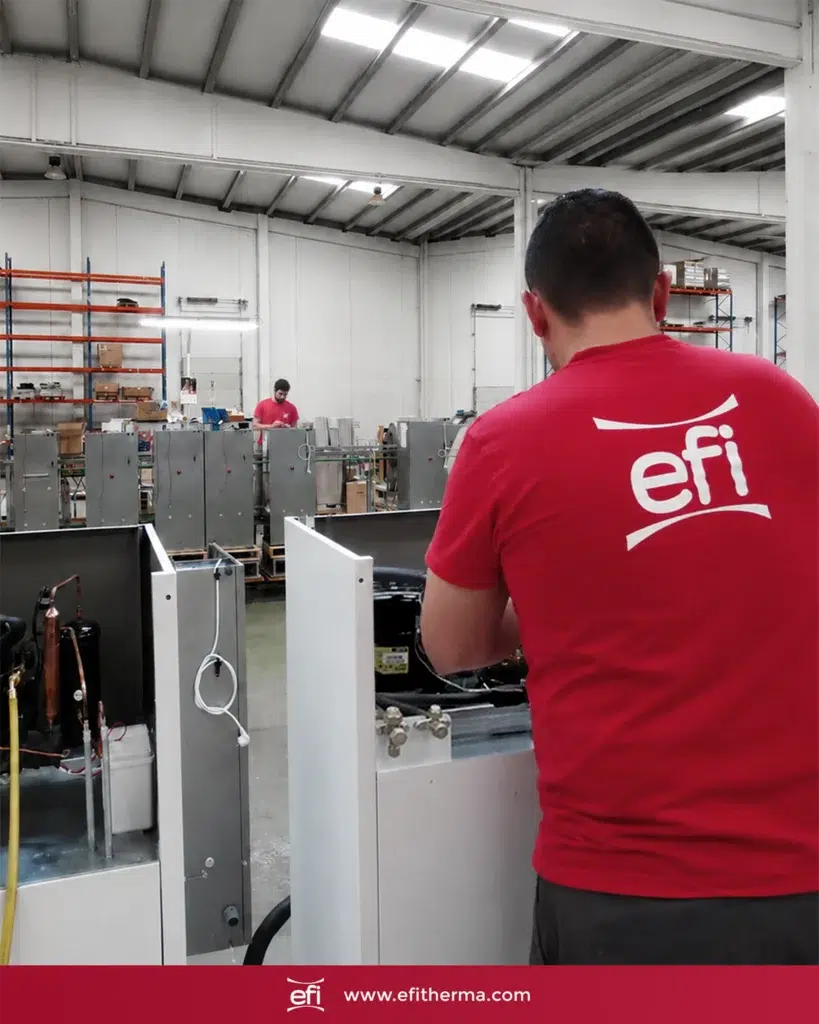
Unlike companies that simply sell third-party heat pumps, at Efitherma we design and manufacture our own heat pumps.
Esto nos permite mantener un control directo sobre aspectos fundamentales como:
Efitherma has developed its own control ecosystem comprising the TST Control Display (Smart heat pump controller) and the EFI SmartApp (Remote control APP). These two tools are designed to provide both users and professionals with complete control over the system.
Its main features include:
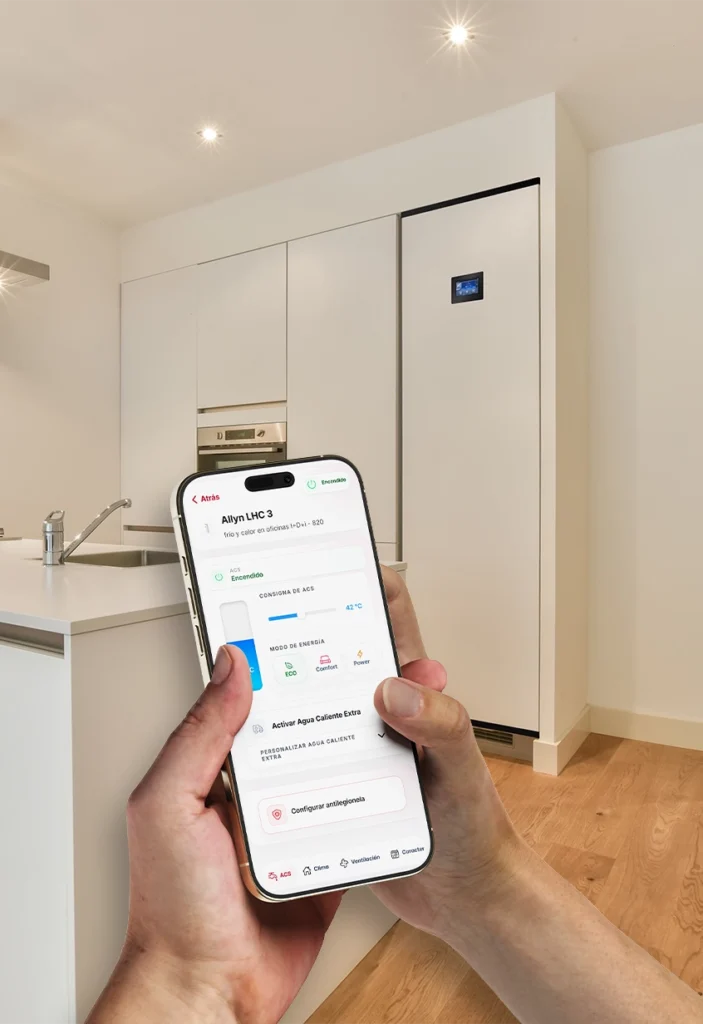
Real-time heat pump operation.
Adjustments to all operating parameters.
Visualización de consumos, estadísticas y rendimiento.
Scheduling and smart management.
Fault diagnosis to facilitate maintenance.
Available for PC / Mobile / Tablet (Android / iOS).
Find out more at:
Contact us and let efficiency do the rest.
Newsletter
Subscribe to our email newsletter to get useful tips and all the latest news.
USEFUL LINKS
DISCOVER Efitherma
CONTACT
NEWSLETTER
Subscribe to our email newsletter to get useful tips and all the latest news.
© EFICIENCIA FUTURO INGENIERIA SL - ALL RIGHTS RESERVED