Efitherma Marketing Department
Efitherma Marketing Department
We are paying more and more attention to our home’s energy consumption, but there is one area of expenditure that often goes unnoticed: the energy used to produce Domestic Hot Water (DHW).
Taking a shower, washing our hands or using hot water in the kitchen are all part of our daily lives, and producing that water requires a significant amount of energy. In fact, it is one of the main uses of energy in the home, second only to heating in most cases.
The DHW heat pump stands out for its high efficiency and for having become one of the most highly recommended solutions for significantly reducing energy consumption.

Domestic Hot Water, known as DHW, is water intended for everyday use in showers, washbasins, sinks and baths. Unlike water used for heating, DHW must be maintained at a suitable temperature to ensure both comfort and health and safety in the installation.
Although consumption may vary depending on the number of occupants and their habits, Domestic Hot Water is available all year round, regardless of the season.
Heating water requires a considerable amount of energy. The greater the temperature difference that is, the difference between the inlet water temperature and the desired temperature the greater the energy consumption required.
Furthermore, the DHW has two features that increase its energy efficiency:
According to studies by the Instituto para la Diversificación y Ahorro de la Energía, domestic hot water is one of the main uses of energy in homes, alongside heating, cooling and kitchen appliances.
There are currently various technologies available for producing Domestic Hot Water, each with a different level of efficiency.
DHW Production System
Energy Efficiency
Electricity or fuel consumption
Whilst an electric water heater converts virtually all the electricity it consumes into heat (1 kWh of electricity generates approximately 1 kWh of heat), a heat pump harnesses the energy present in the air to boost the system’s efficiency.
There are currently various technologies available for producing Domestic Hot Water, each with a different level of efficiency.
Whilst an electric water heater converts virtually all the electricity it consumes into heat (1 kWh of electricity generates approximately 1 kWh of heat), a heat pump harnesses the energy present in the air to boost the system’s efficiency.
The main difference is that a heat pump does not generate heat directly using electric heating element, but rather transfers it from the outside air or the ambient air to the water in the tank via a thermodynamic cycle.
Thanks to this physical principle, it can provide several kilowatt-hours (kWh) of thermal energy for every kWh of electricity consumed.
For example, a heat pump with a COP of 4 can produce approximately 4 kWh of heat using just 1 kWh of electricity, provided that the operating conditions are suitable.
For this reason, heat pumps are regarded as one of the most efficient technologies for producing Domestic Hot Water and play a key role in new-build and refurbishment projects as systems promoted by the European Union.
Yes, it is possible, although it will always depend on the system being replaced and the conditions in which the property is used.
When a heat pump replaces a conventional electric water heater, energy consumption for DHW can be reduced by up to 75 %, particularly in correctly sized installations and with high-efficiency units. This figure is widely accepted within the sector and is in line with the savings ranges indicated by manufacturers and specialist organisations for this type of replacement, as is the case with the manufacturer Efitherma.
However, the actual savings may vary depending on factors such as:
That is why it is more accurate to view energy savings as the result of combining efficient technology with a well-designed installation and proper use.
Keeping DHW at a suitable temperature prevents unnecessary consumption and reduces heat loss.
Smart systems adjust production to avoid heating water when it is not going to be used.
IDAE recommends insulating storage tanks and pipes to minimise heat loss.
It ensures that the heat pump continues to operate at maximum efficiency throughout its service life.
Some of the electricity consumed by the heat pump is generated by the solar panels, further reducing the cost.
The transition to more efficient buildings involves replacing obsolete combustion technologies or electric heating elements with systems capable of making better use of the available energy.
In this context, the heat pump has established itself as one of the most efficient solutions for producing domestic hot water, offering a balance between energy savings, comfort and reduced emissions.
Every home is different and the savings will depend on a number of factors, but one thing is clear: producing hot water efficiently is no longer an exclusive option.
Which brand should I choose?
Efitherma is a manufacturer of heat pumps that offer maximum performance, efficiency and comfort in all types of installations.
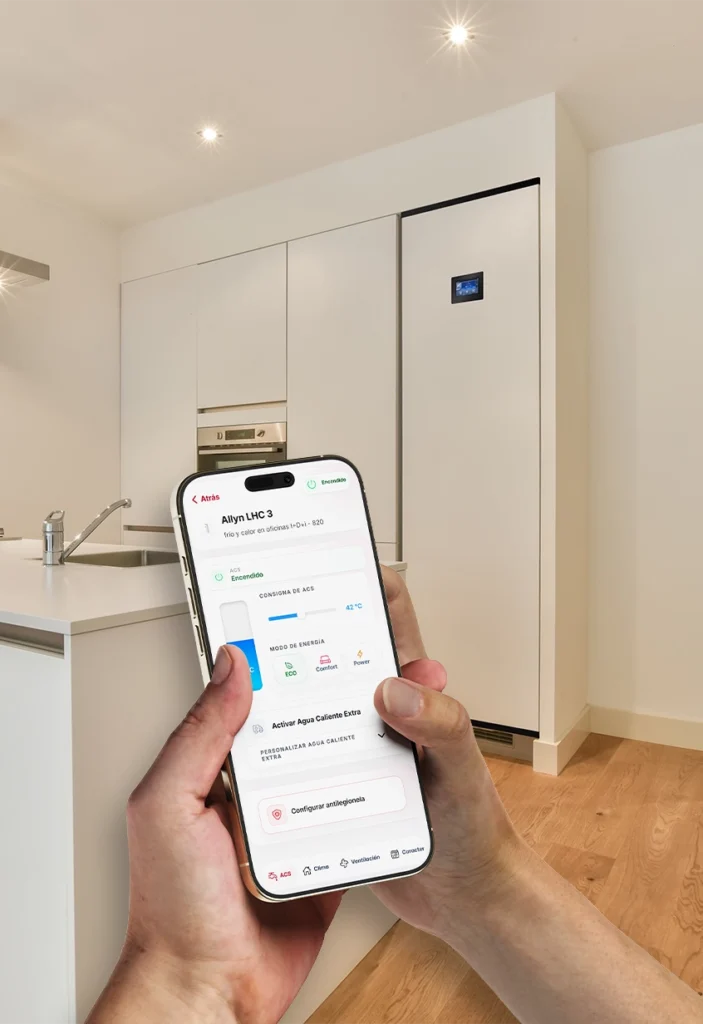
Among their solutions, they develop systems capable of integrating the following into a single system: domestic hot water, ventilation, air conditioning, hybrid systems and retrofit solutions. These heat pumps help to optimise space, simplify installations and improve the overall energy efficiency of the home or building.
All of this results in more efficient facilities, better energy management and a much more comprehensive user experience.
Newsletter
Subscribe to our email newsletter for useful tips and all the latest news
Contact us and let efficiency do the rest
NUESTROS PROYECTOS
Enlaces útiles
Descubre Efitherma
Contacto
Redes sociales
NEWSLETTER
Suscríbase a nuestro boletín de correo electrónico para obtener consejos útiles y todas las novedades
Newsletter
Subscribe to our email newsletter to get useful tips and all the latest news.
USEFUL LINKS
DISCOVER Efitherma
CONTACT
NEWSLETTER
Subscribe to our email newsletter to get useful tips and all the latest news.
© EFICIENCIA FUTURO INGENIERIA SL - ALL RIGHTS RESERVED