

Efitherma Marketing Department
Efitherma Marketing Department
If you’re looking for an efficient and sustainable system to heat your home, you’ve probably heard of aerothermal and thermodynamic heating. Both systems use renewable energy to heat and cool spaces, but they have key differences that may influence your decision. In this article, we explain in a simple way how they work, their benefits, which may be the best option for your home and you will also learn how to choose the best electricity rate with Hello Watt to obtain maximum savings.

A heat pump is a device that transfers thermal energy from a low-temperature source (such as air, water or ground) to produce heating, cooling or hot water.
Heat pumps can be classified according to the heat source from which they extract energy and the medium to which they transfer that heat to heat spaces or heat water. Here is a general classification based on these characteristics:
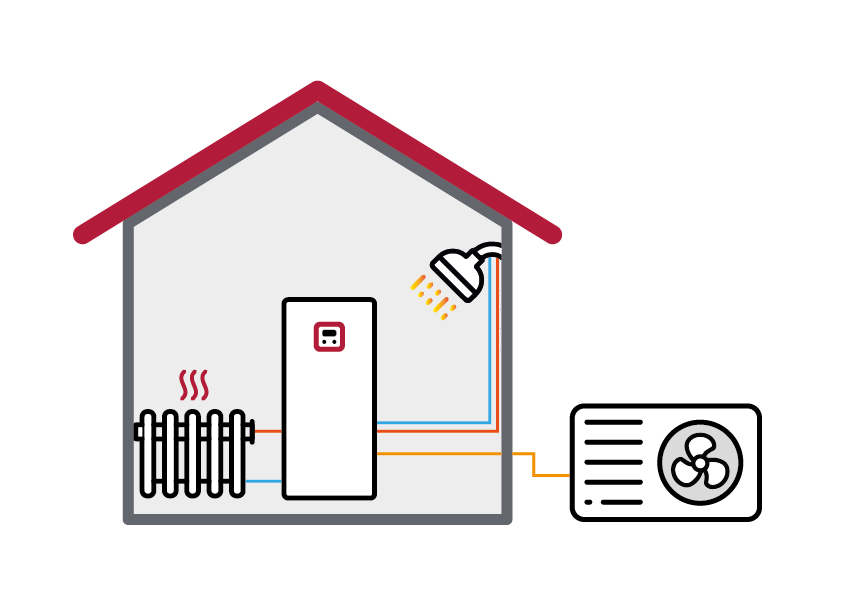
Heat pump with outdoor unit

Monoblock heat pump

Heat pump with outdoor unit
Aerothermal energy is a heat pump-based technology that refers to the use of air-water heat pumps. This type of heat pump uses the outside air as a source of thermal energy and transfers that energy to water. The heated water can be used for radiator heating systems, underfloor heating, or to provide hot water for sanitary use. So, when we talk about aerothermal energy, we are specifically talking about heat pumps that operate in the air-water configuration.
2. This energy is transferred to a refrigerant gas which is compressed and increases in temperature.
3. The heat generated is distributed to the home’s heating system (low-temperature radiators, underfloor heating or fan coils).
4. In cooling mode, the process is reversed and the thermal energy inside is expelled to the outside.


The system extracts energy from the outside air and also expels cold air to the outside. It is necessary to duct the air inlet to the equipment and the air outlet from the equipment.

The system extracts energy from the indoor air of the home in an unheated area, whose dimensions and ventilation conditions allow it to be used as an energy source, and discharges the cold air into this or another area that allows it.

The system extracts energy from the interior air of the home in an area that is not heated, and the air is expelled to the outside through a ducted tube.
Thermodynamics based on the aerothermal heat pump system (air-water), which is characterized by incorporating a thermodynamic panel that captures thermal energy from the outside air and solar radiation to transfer it to a cooling circuit. This circuit transports the heat to an exchanger, where it is transferred to the water contained in the storage tank or to the heating system.
Their operation is highly efficient, as they can operate even in adverse weather conditions and with low outside temperatures.
2. The refrigerant gas absorbs this energy and evaporates.
3. The compressor raises the temperature of the evaporated gas.
4. The heat is transferred to the water for the heating system or DHW.


Thermodynamic panels are an innovative solution for producing hot water for sanitary use and heating. The coolant contained inside circulates in a liquid state and evaporates when it absorbs heat from the environment. This gas is then compressed in a closed circuit to increase its temperature and transfer the heat to the water stored in a tank. In this way, hot water is produced efficiently and with reduced electricity consumption.
Operation without direct solar radiation: They can capture heat even in adverse weather conditions (fog, rain or snow).
Long service life: The roll-bond aluminium structure provides a durability of over 25 years, with practically zero maintenance.
Rain and wind: Elements such as rain help to renew the temperature on the surface of the panel, promoting heat absorption.
Adaptable: They can be mounted either horizontally or vertically, adapting to different spaces and needs.
Lightweight and versatile design: Weighing just 6.2 kg, the panels can be installed on a variety of surfaces without the need for structural reinforcements. estructurales.
| Characteristics | Aerothermal energy | Thermodynamics |
|---|---|---|
|
Energy source
|
Outdoor or indoor ambient (wet areas such as: kitchen, bathrooms, etc.)
|
Outdoor ambient and solar radiation
|
|
Efficiency
|
High efficiency
|
Efficiency even in extreme temperatures
|
|
Installation
|
You may or may not need an outdoor unit depending on the heat pump model and its function.
|
Requires at least one thermodynamic panel installed outside.
|
|
Applications
|
Heating, cooling and domestic hot water
|
Heating and Domestic Hot Water
|
|
Electricity consumption
|
Low or very low (depending on the heat pump model)
|
Low or very low (depending on the heat pump model)
|
These devices are connected to the electrical grid, so it is essential to contract an appropriate electricity rate to optimize energy savings. Despite being sustainable and low-consumption systems, the activation of electrical resistors can increase energy expenditure, so choosing a rate here that favors the efficient use of electricity is key to maximize its performance and minimize operating costs.
The choice between aerothermal and thermodynamic depends on several factors:
Newsletter
Suscríbase a nuestro boletín de correo electrónico para obtener consejos útiles y todas las novedades
Smart solutions for a sustainable home
Enlaces útiles
Descubre Efitherma
NEWSLETTER
Suscríbase a nuestro boletín de correo electrónico para obtener consejos útiles y todas las novedades
Newsletter
Subscribe to our email newsletter to get useful tips and all the latest news.
USEFUL LINKS
DISCOVER Efitherma
CONTACT
NEWSLETTER
Subscribe to our email newsletter to get useful tips and all the latest news.
© EFICIENCIA FUTURO INGENIERIA SL - ALL RIGHTS RESERVED